Local Storage seems to be disabled in your browser.
For the best experience on our site, be sure to turn on Local Storage in your browser.

AXD001004SD

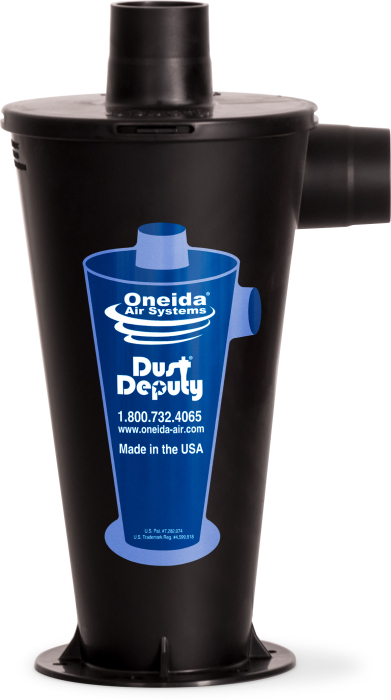
Static Dissipative Dust Deputy DIY Cyclone Separator

$59.95

Original, patented, cyclone design stops up to 99.9% of fine dusts and bulk debris from clogging your vacuum's filter - eliminating suction loss while saving you time and money on expensive replacements! DIY SD kit is ideal for commercial applications building their own dust collection system!

  • Upgrades any make/model shop vacuum with 1.5" to 2.5" hose fittings.
  • Neutral-vane technology improves separation efficiency by 20%.
  • Mounts to any size and type of reinforced, airtight container.
  • Static conductive components preserve the grounding pathway for electronically sensitive applications.

Static-Safe Cyclonic Separation for Industrial Applications

The Static Dissipative Dust Deputy® DIY cyclone is molded from an industrial static conductive resin. It's specifically designed for use in applications where a high degree of grounding conductivity is needed and for vacuums with a static grounding inlet. It provides maximum static conductivity while retaining the ultra-high particle separating efficiency of the original Dust Deputy design.

This simple and efficient design can be adapted for use with any make, size, or model shop vacuum. It also features tapered 2.0" inlet and outlet ports that fit the cuffed 2.5" hoses that come standard with most shop vacuums. With the DIY version, your Dust Deputy system is limited only by your imagination! It can be used with any size, shape, or type container as long as it has an air-tight seal.

How Does It Work?

The original and still the best! Now 20% more efficient with Neutral Vane Technology, the patented design of the Dust Deputy cyclone uses centrifugal force to capture and remove up to 99.9% of dust and debris from the air-stream before it reaches your vacuum's filter; eliminating clogged filters and suction loss! The Dust Deputy will save you significant time and money on expensive replacement filters and dust bags, and keeps your wet/dry vac operating at peak performance!

Learn More

If used with a 5 gallon bucket, the bucket must be a minimum of 90 mils thick (0.09") or else it may collapse under vacuum pressure. Big box store buckets are not thick enough for use with the Dust Deputy.

Static testing of the Dust Deputy DIY SD
The Dust Deputy DIY SD Undergoing 3rd Party Static Testing
More Information
SKU AXD001004SD
Cyclonic Separation Efficiency Removes over 99% of fine wood dusts
Airflow Rating Minimum 50 CFM
Waste Capacity Customizable
Inlet Size 2" O.D. (Tapered)
1-3/4" I.D.
Outlet Size 2" O.D. (Tapered)
1-3/4" I.D.
Discharge Size 3" I.D.
Primary Build Materials Static Dissipative Polypropylene
Static Resistance Rating Static Conductive
Color Black
Width 8"
Depth 6.75"
Height 13.5"
Height to Center of Inlet 9.75"
Actual Weight (lbs) 3.00
Contents Cyclone, Foam Gasket, Mounting Hardware
Manufacturer Oneida Air Systems
Manufacturer Statement Made in USA
Warranty Information 1 Year Limited Warranty
Proposition 65 WARNING: This product may expose you to chemicals, including Carbon Black (airborne, unbound particles of respirable size), which is known to the State of California to cause cancer or birth defects or reproductive harm.
All-Clear Components
How Cyclone Separators Work
How to Assemble the Deluxe Kit
Cyclonic Separation Efficiency
Dust Deputy vs Dustopper Comparison
Air Velocity Testing
Product Overview
How do I prevent my bucket from collapsing with my Dust Deputy or Low-Pro?
Ensure your bucket is not old, damaged, or thin-walled. To increase the strength of a thin-walled bucket, you can stack two buckets together. Two stacked thin-walled buckets will work well to avoid bucket collapse. Ideally, we recommend a bucket with a 90 mil wall thickness or higher. A 90-mil or higher walled bucket will completely avoid bucket collapse.
What vacuum do you recommend for the Dust Deputy?
The Dust Deputy can be used with any make, model, or size wet/dry vacuum with an inlet ranging from 1.5" to 2.5" in size. We recommend that it has an airflow rating of at least 50 CFM to ensure optimum dust separation performance.
What is the difference between the black Dust Deputy and the clear one?
The black version provides maximum static conductivity for applications that require a high degree of grounding conductivity, and for vacs with a static grounding inlet.
What is the California Proposition Black Carbon warning?
By California law, Oneida Air Systems is required to provide advance notice to customers of potentially hazardous materials included in our products. This requirement is enforced regardless of how much of that material is present in the actual product. The black, static dissipative resin used to create this cyclone separator contains carbon black, which is a chemical considered as "possibly carcinogenic to humans" (Group 2B) when the chemical is an airborne, particulate form. This form would not be typical of normal use of the cyclone, but the law requires this statement be provided regardless.
What type of dust bin works best?
You can use any shape or size container for your Dust Deputy cyclone. Keep in mind that the smaller the container, the more often you'll have to empty it. The dust container you provide must be able to be sealed airtight for the best performance. Foam gaskets or silicone caulk can help provide an airtight seal. Containers must also be strong enough to withstand the pressure created by your vacuum. For plastic buckets, we recommend at least a 90 mil. wall thickness; otherwise, the container may collapse when in use. Browse Dust Containers
How does the Low-Pro compare to the taller cyclones?
The separation efficiency is comparable between the Low-Pro and original Dust Deputy - both are rated for up to 99.9% of dust and debris. Click "Read More" to learn more about the differences between the Dust Deputy cyclones.
Will the Dust Deputy cyclone work if my tool has its own fan blower?
In most cases, yes - but the cyclone's efficiency will vary based on whether your vacuum is also turned on. The Dust Deputy cyclone needs a consistent airflow rate to "spin" the dust out of the airstream; If your tool's fan blower is pushing air in while your vacuum is also sucking air out, this can disrupt the airflow rate and reduce the cyclone's separation performance. In many cases, the fan blower on tools (such as planers) cannot be turned off. If that is the case for you, try collecting your dust with the vacuum turned off. In doing so you will be creating a positive pressure system as the tool's fan blower pushes air through the Dust Deputy cyclone. This method may not work with every vacuum
How do I troubleshoot an air leak with my Dust Deputy cyclone?
Even a small leak can significantly affect the overall separation performance of the cyclone. If you can't audibly pinpoint where the leak might be coming from, one of the simplest ways to check for air leaks is with a smoke test. Click "Read More" for further instructions and tips.
What is a static conductive material?
This term refers to the range of conductivity that a material has. Static conductive materials range from 101-106 Ohms. More information about static resistance can be found here.
What is a static dissipative material?
Static dissipative (SD) refers to the material's electrical conductivity. SD materials are superior to anti-static (AS) materials, but not quite as good as conductive or static conductive (SC) materials in terms of reducing static charge build-up.
Can I use the Dust Deputy with my 4" hose / port?
No. The standard Dust Deputy cyclones are designed for use with ports/hose that are 1" to 3" in diameter. Connecting 4" tools to the Dust Deputy cyclone's 2" ports will result in significant losses in airflow and suction power. Larger ports (4" and larger) will instead require one of our Super Dust Deputy cyclones.
Can I use this cyclone with smoldering or abrasive debris?
No. This cyclone is designed for use with light debris such as wood dust. For heavy-duty applications with highly abrasive or smoldering materials, we recommend our steel, Heavy-Duty Dust Deputy kits instead.
Can I remove the top portion of the Dust Deputy?
No, it is not advised. This can cause damage to the cyclone and is not covered under warranty.
What are the minimum specs needed for the Dust Deputy?
Rather than worrying about what specs your vacuum needs (e.g. air watts, cfm, static lift, etc.), we at Oneida Air Systems have a much simpler approach - simply match the size of your vacuum's inlet to the size of the Dust Deputy cyclone's ports. The Dust Deputy cyclone's tapered 2" ports are designed to work with any make and model wet/dry vacuum on the market today, regardless of horsepower, wattage, etc. Most vacuums will have an inlet ranging from 1.5" to 2.5" in diameter - perfect for our cyclone. Keep in mind that every component installed onto your vacuum will have an effect on the system's suction power. That includes your hose, hose attachments, adapters, elbows, couplers, etc.
How do I connect the Dust Deputy to a snap-on inlet?
Other adapters may be necessary to connect the Dust Deputy to non-standard sized or locking-type inlets. Click "Read More" to see adapter suggestions.
We found other products you might like!
Frequently Bought Together
Total price
What's this? Check "Remember Me" to access your shopping cart on this computer even if you are not signed in.